



Pacific sits at a crossroads, literally and figuratively. It is a working community with a mix of long-established homes and newer builds, and the people here tend to value straight talk and reliable work over flashy sales pitches. That is exactly how Saylors Systems Heating and Air operates.
We service all types of central cooling systems found throughout Pacific, from older units in homes near the historic downtown to more recently installed equipment in residential developments off Highway 100. Whatever generation of equipment you are running, we arrive ready to diagnose it accurately and repair it correctly.
Our repair work covers the full range of AC failures, including refrigerant issues, capacitor and contactor replacement, compressor diagnostics, evaporator coil problems, condensate drain blockages, blower motor failures, and thermostat malfunctions. We explain what we find before we do anything, and we do not recommend work that is not needed.
Pacific summers are no different from the rest of Missouri when it comes to heat and humidity, and a cooling system that is starting to fail will usually give you some notice before it quits. Here is what to watch for.
If your system is showing any of these signs, scheduling a service call now is much easier than dealing with a full breakdown on a 95-degree afternoon.
Pacific’s location along the Meramec River valley gives it a geography that directly affects how hard cooling systems have to work. The river corridor funnels warm, moist air through the area during summer months, and the surrounding bluffs and hills limit the natural air movement that might otherwise help dissipate heat. The result is a humidity profile that tends to be higher than what communities sitting on flatter terrain experience, and AC systems here carry a heavier dehumidification load as a result.
The housing stock in Pacific spans a wide range of eras. Homes near the original town center date back generations, and many have seen multiple rounds of HVAC updates without any changes to the underlying duct infrastructure. Old galvanized and flex duct runs that were adequate for equipment installed 30 years ago create airflow restrictions for modern systems, leading to uneven cooling, increased runtime, and premature component wear.
Pacific also has a meaningful number of homes built on slab foundations or with low crawl spaces, configurations that introduce their own challenges. Slab homes concentrate all the ductwork in the attic, where summer temperatures can reach 130 degrees or more. Ducts running through that kind of heat bleed conditioned air before it ever reaches the living space, forcing the system to run longer cycles just to meet the thermostat setting.
Flooding history along the Meramec adds one more layer. Homes that have experienced water intrusion, even years ago, sometimes carry residual moisture issues in lower-level mechanical spaces. That ambient humidity accelerates corrosion on electrical components and shortens the life of coils and drain systems in ways that are easy to attribute to simple aging.
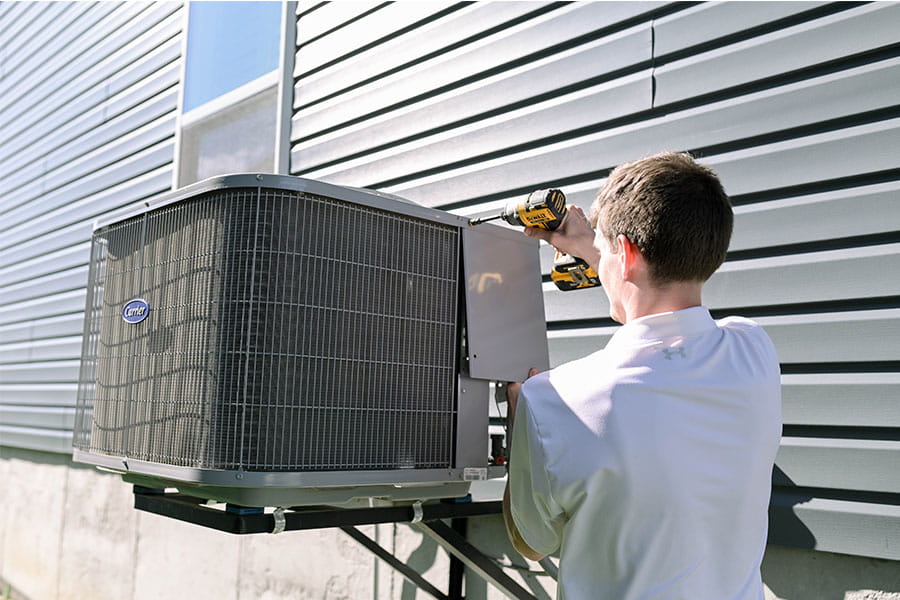
Donna called on a Wednesday in late June after her AC had been struggling for about a week. The house was cooling, but not the way it used to, and she could hear the outdoor unit running almost nonstop from sunup to sundown.
Her home near First Street had a system that was about 14 years old. When our technician pulled the panel on the air handler, the evaporator coil had a heavy layer of buildup that had been restricting airflow for what looked like at least a full season. The blower was also running slower than it should, and we traced that to a failing run capacitor on the motor. The system was working, but it was working against itself.
We cleaned the coil, replaced the capacitor, and checked the refrigerant charge while we were in there. The difference was immediate. Donna said the house reached her set temperature for the first time in weeks within a couple of hours of us leaving. A little maintenance earlier in the season would have caught both issues before they started compounding each other.
Pacific is the kind of community where people remember who showed up and did right by them, and that reputation matters to us. Saylors Systems was built by Austin and Danielle Saylors on the straightforward idea that good HVAC service means being honest about what you find and doing quality work regardless of the size of the job.
We are not a franchise and we are not chasing volume. We are a small team that takes the work seriously and wants every customer in Pacific to feel like they got a fair deal and a job done right.
Continuous running without reaching the set temperature usually points to a dirty coil, low refrigerant, restricted airflow, or duct issues losing conditioned air before it reaches the living space. Homes with attic ductwork in Pacific are especially prone to this during peak summer heat. A technician can trace the specific cause quickly.
Yes. Past water intrusion can leave behind elevated moisture levels in crawl spaces and lower mechanical areas that never fully resolved. That ongoing humidity accelerates corrosion on electrical components and shortens the life of coils and drain pans. If your home has a flood history, it is worth mentioning when you schedule service.
The river corridor tends to pull in warm, moist air during summer months, which raises the ambient humidity in the area compared to communities on flatter terrain. Your AC has to work harder to remove that moisture from your home, and systems that are aging or undersized will struggle to keep up with both cooling and dehumidifying at once.
At 14 years, a system is in the range where the answer depends on the repair cost, the overall condition, and whether it has been maintained regularly. We will walk you through both options honestly so you can decide what makes sense for your home and budget without feeling pushed in either direction.
Continuing to run a struggling system puts added stress on components that may already be weakened, and it can turn a manageable repair into a compressor failure or full system replacement. If something feels off, it is better to have it checked sooner rather than waiting until it stops working entirely.
Yes, and we see it regularly in Pacific and throughout the area. Attic duct systems come with their own set of challenges, particularly around insulation and heat gain during summer. We factor that into our diagnosis and let you know if the duct condition is contributing to the problem we are there to fix.