



Sappington is a well-established community where homes have history and homeowners tend to know what they want from a service company. At Saylors Systems Heating and Air, we fit that expectation. We diagnose accurately, communicate clearly, and fix what needs fixing without padding the bill with work that is not necessary.
We work on the full spectrum of cooling systems found throughout Sappington, including the older central air setups common in mid-century ranch homes and the updated equipment installed during more recent renovation waves. Age of the system is not a barrier. We come prepared to work on whatever we find.
Every repair call covers a thorough diagnostic before any recommendation is made. We handle refrigerant leaks and recharges, capacitor and contactor replacements, compressor evaluations, evaporator coil cleaning and repair, condensate drain service, blower motor issues, and electrical faults throughout the system. You get a clear explanation of the problem and the fix before we do anything.
The signal that something is wrong with your AC rarely arrives all at once. Sappington summers are long and humid, and a system under stress will usually give you several weeks of warning before it fails completely. These are the signs worth taking seriously.
Sappington’s older homes in particular can mask some of these symptoms for a while, since residents are sometimes used to their systems running a bit harder than average. If something feels off, trust that instinct and get a technician in before the problem compounds.
Sappington developed primarily during the postwar suburban expansion of the 1950s and 1960s, and that timing is stamped into the bones of nearly every home in the area. Ranch-style construction dominated that era, and the single-story layout with low-pitched rooflines means attics tend to be shallow and poorly ventilated by modern standards. Heat that builds in those attic spaces radiates directly into the living area below, adding a passive heat load that forces cooling systems to work harder than they would in a better-insulated home.
Ductwork is another defining characteristic of this housing stock. Many Sappington homes still have their original sheet metal ducts, which were sized and designed around equipment from a completely different era. When those systems were updated over the decades, the ducts stayed. The result is often a mismatch between what the new equipment can move and what the duct system allows, creating static pressure problems that reduce efficiency and accelerate wear on the blower and compressor.
South St. Louis County also sits in a corridor that captures late-afternoon sun exposure on west-facing walls and windows without much topographical relief to moderate it. For ranch homes with large west-facing surfaces, that solar gain in the late afternoon is substantial. Systems that were sized for average conditions can fall behind on days when outdoor temps peak in the upper 90s and the sun is still hammering the side of the house at 5 p.m.
One more pattern worth noting is refrigerant. Systems that are 15 years or older and have never had their refrigerant levels checked often turn out to be running low from slow leaks that built up over time. The system still cools, just less effectively each season, until one summer it simply cannot keep up at all.
It was a Tuesday in mid-July when Beverly called. Her system had been keeping the house at 76 degrees when she wanted 72, and she had been adjusting the thermostat lower and lower trying to compensate, which was only making the system run longer without actually solving anything.
Her home in Sappington Acres was a classic 1960s ranch with original ductwork still in place. When our technician checked the system, the refrigerant was noticeably low, the evaporator coil had significant dust buildup restricting airflow, and one of the supply duct connections in the crawl space had partially separated, bleeding conditioned air into an unconditioned space rather than into the home.
We located and repaired the refrigerant leak, cleaned the coil, reconnected and sealed the duct, and brought the refrigerant charge back to spec. Beverly’s home hit 72 degrees for the first time in what she estimated had been two full summers. Three separate issues had been stacking up quietly, each one manageable on its own but together enough to make the system feel like it was failing when it technically was not.
Sappington homeowners have often been in their homes for years and have dealt with their share of contractors. They know the difference between a company that respects their time and one that does not. Saylors Systems was built to be the former. Austin and Danielle Saylors started this business with a commitment to honest diagnostics, fair recommendations, and work that holds up.
When we leave a job in Sappington, we want the homeowner to feel like they got a straight deal and a repair that actually solved the problem. That standard does not change based on the size of the invoice.
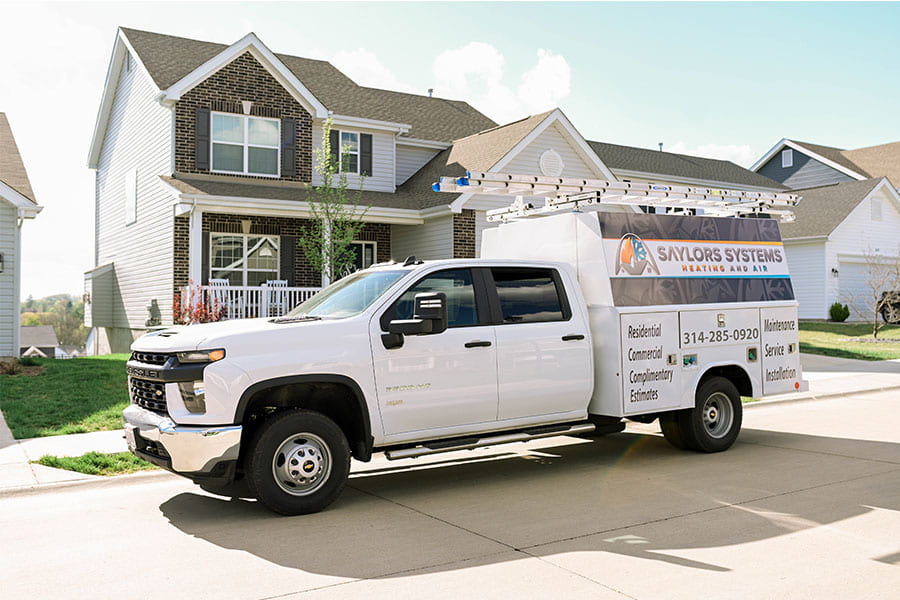
West-facing walls and windows in single-story ranch homes absorb significant solar heat in the late afternoon, and shallow attics provide little buffer. Your AC may be working fine but simply cannot outpace that heat gain during peak sun hours. Improving attic insulation and sealing duct connections can reduce the load meaningfully.
It can be several things. Low refrigerant, a dirty evaporator coil, a partially disconnected duct, or a system that is undersized for the heat load are all common causes. In older Sappington homes, it is often a combination of factors that have built up over time rather than one single failure point.
Signs include uneven cooling between rooms, the system running longer than expected, higher energy bills, and excessive noise from the vents. A technician can measure static pressure in the duct system to determine whether airflow restrictions are working against your equipment.
Recharging refrigerant without finding and fixing the leak is a short-term fix. We always locate the source of the loss first. If the system is older but otherwise in good condition, a proper leak repair and recharge can give you several more reliable seasons. We will be honest with you about whether the repair makes sense for the age and condition of your equipment.
It is worth having them checked any time you have service done, especially in homes with original ductwork from the 1950s and 1960s. Connections can loosen or separate over decades without any obvious signs inside the house, and a partially disconnected duct can quietly rob your system of significant cooling capacity.
Turn the system to fan-only to give the compressor a rest, then call us. Running a struggling system at full load for extended periods accelerates wear on the compressor. A technician can identify whether the issue is a refrigerant problem, airflow restriction, duct loss, or something else entirely and get it resolved before it becomes a larger failure.