


Town and Country homeowners are accustomed to a high standard of service, and when the AC stops performing in a home of this size and complexity, the stakes are higher than average. At Saylors Systems Heating and Air, we bring the same thorough, honest approach to every repair call here that we bring everywhere else, because good work does not change based on the zip code.
We service the full range of cooling equipment found in Town and Country, including multi-zone systems, multiple air handlers, high-capacity units, and the mix of older and newer equipment that results from decades of phased upgrades in larger estate homes. We come prepared for complexity and we do not cut corners to speed things along.
Every repair begins with a thorough diagnostic. We address refrigerant leaks, compressor and capacitor failures, zone control malfunctions, evaporator coil issues, condensate drainage failures across multiple drain lines, blower motor problems, and electrical faults at the air handler and disconnect. You get a clear explanation of what we found and what the fix involves before any work begins.
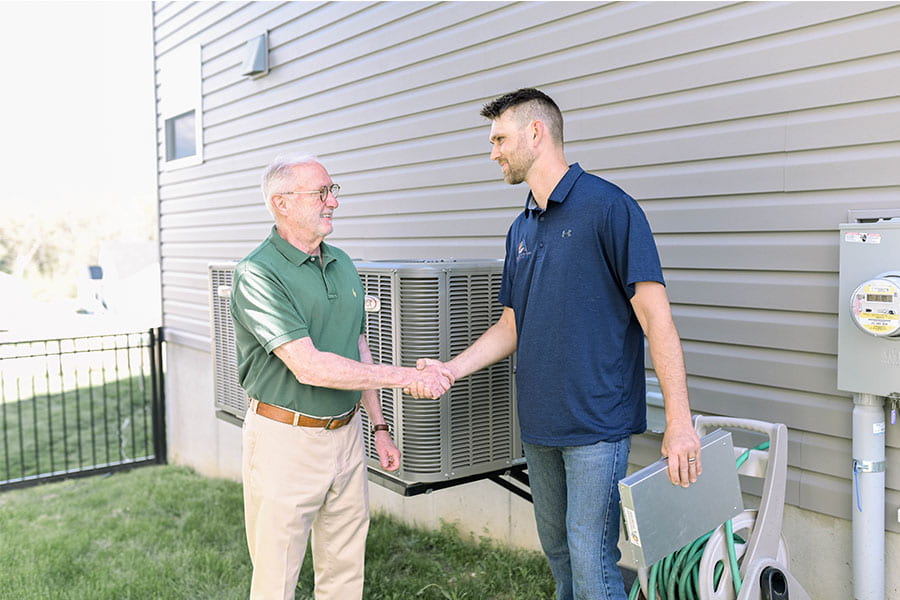
In a larger home, a cooling system that is starting to fail can fall behind gradually, floor by floor and room by room, before it becomes an obvious breakdown. These are the signs that something needs attention in Town and Country homes.
Because many Town and Country homes run multiple systems or complex zoning setups, a problem in one part of the system can go undetected for an entire season if the rest of the home is still comfortable.
Town and Country is defined by its estate-scale properties, and that scale introduces a set of HVAC demands that simply do not exist in smaller residential settings. Homes here routinely exceed 5,000 square feet, and many have gone through multiple additions, renovations, and system upgrades over the decades. The result is often a patchwork of equipment generations and duct configurations that were never designed to work together as a unified system.
Multi-zone configurations are the norm rather than the exception in Town and Country, and they come with their own failure points. Zone dampers, actuator motors, and zone control boards are mechanical and electronic components that wear independently of the main HVAC equipment. A single failed damper can leave an entire wing of the home without cooling while the rest of the system appears to be operating normally, making diagnosis more involved than a standard single-zone repair.
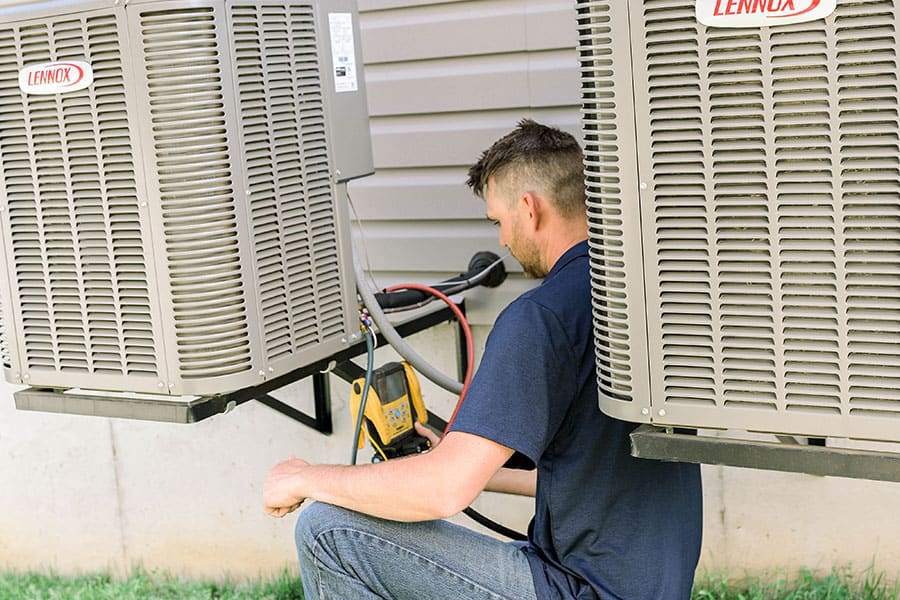
The wooded, acreage-style lots that give Town and Country its distinctive character create outdoor conditions that work against condensing unit performance. Multiple outdoor units are common on properties of this size, and units tucked into landscaping beds or surrounded by mature plantings frequently deal with restricted airflow around the coil. When that restriction is combined with Missouri’s sustained summer humidity, the compressor runs under elevated stress for extended periods, shortening its effective lifespan even in systems that are otherwise well maintained.
Indoor air quality is also a more prominent concern in homes of this size. Larger duct networks accumulate more particulate over time, and homes with high ceilings and extensive square footage tend to circulate air through longer duct runs where buildup compounds. A system that is cooling adequately may still be contributing to air quality issues that are not obvious until someone starts noticing symptoms.
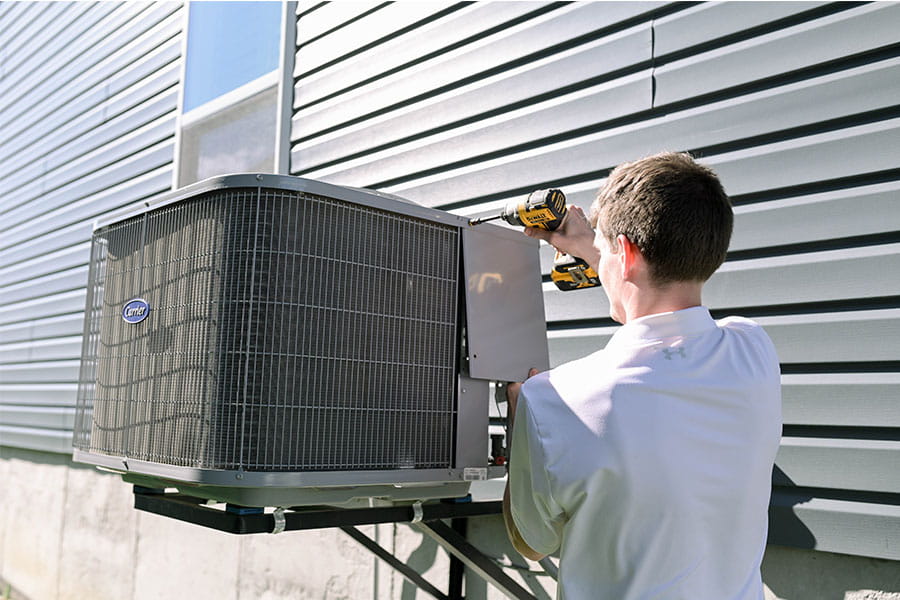
Catherine contacted us in July after noticing that the east wing of her home, which included the primary suite and a sitting room, had been running noticeably warmer than the rest of the house for several weeks. The main living areas were comfortable, so she had held off on calling, assuming it might resolve on its own.
Her home in Kehrs Mill Estates ran a three-zone system. When our technician arrived, one of the zone dampers serving the east wing had failed in the partially closed position, starving that section of the home of conditioned air. On top of that, the air handler serving the upper level had a condensate drain line that was fully blocked, with water backing up into the drain pan. The float switch had not yet triggered a shutoff, but it was close.
We replaced the damper actuator, cleared and flushed the condensate line, and tested all three zones through a full cycle before leaving. Catherine’s east wing was back to matching the rest of the house within a couple of hours. Two separate issues in one visit, neither one dramatic on its own, but together they had been making a large portion of a well-appointed home uncomfortable for most of the summer.
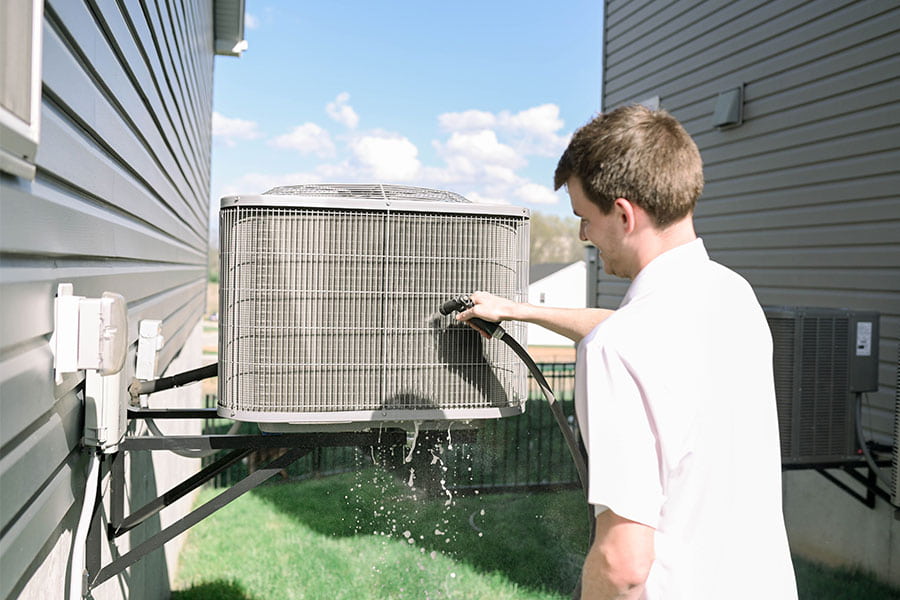
Homeowners in Town and Country have options when it comes to HVAC service, and they tend to choose based on trust rather than price alone. Saylors Systems has built that trust by doing exactly what we say we will do, showing up when promised, diagnosing accurately, and recommending only what a home actually needs.
Austin and Danielle Saylors built this company on the idea that trust is earned job by job, and every call in Town and Country gets the same careful attention we would give our own home.
In multi-zone systems, a failed zone damper or actuator motor is one of the most common causes. The damper controls airflow to that section of the home, and when it sticks in the closed or partially closed position, conditioned air cannot reach that zone. The main system can appear fully operational while one area of the home gets little to no cooling.
Larger homes often run two or more outdoor condensing units, each paired with its own air handler. Each unit operates independently and needs its own annual service, refrigerant check, and diagnostic evaluation. It is easy for one unit to be serviced consistently while another goes years without attention, and the neglected unit is usually the first to fail.
Yes. When a drain line clogs, water backs up into the drain pan and can overflow into the air handler, surrounding cabinetry, or the ceiling below. Most systems have a float switch that shuts the unit off before overflow occurs, but those switches can fail too. Keeping drain lines clear is one of the simpler and more important maintenance tasks for any home, and especially for larger homes with multiple drain lines.
Almost certainly. Additions and renovations frequently result in extended duct runs, added zones, and equipment upgrades that were not part of a unified system design. Over time, those patchwork configurations can create airflow imbalances, pressure issues, and uneven cooling that are difficult to trace without a thorough diagnostic. We see this regularly in Town and Country homes and are experienced at working through the complexity.
Humidity control is a significant part of what your AC does, and in a large home with more square footage to dehumidify, that load is proportionally heavier. A system that is low on refrigerant, has a fouled coil, or is running at reduced capacity will cool the air temperature but struggle to pull moisture out effectively. The result is a home that feels clammy even when the thermostat reads correctly.
Annual maintenance on every system in the home is the most important step, ideally before cooling season begins. That means servicing each air handler and outdoor unit individually, checking all zone components, clearing every condensate drain line, and verifying refrigerant levels across all systems. Homes with multiple systems have more components that can fail, and staying ahead of wear is far less disruptive than reacting to a breakdown mid-summer.